NAICS vs. SIC codes: how to build industry filters that survive a crosswalk
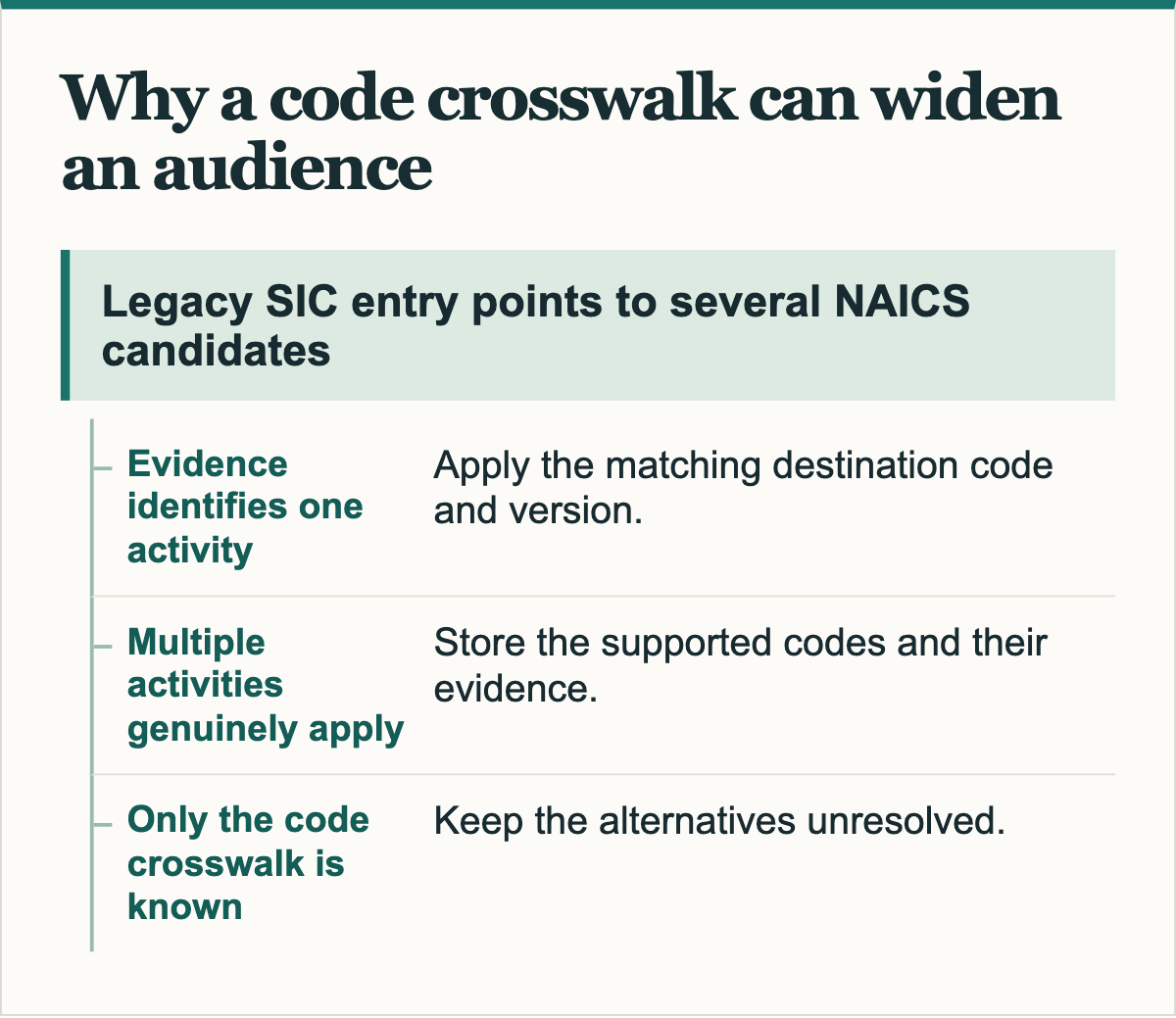
A crosswalk can map one SIC code to several NAICS industries. The ambiguous records matter most when a customer’s filter selects only one.
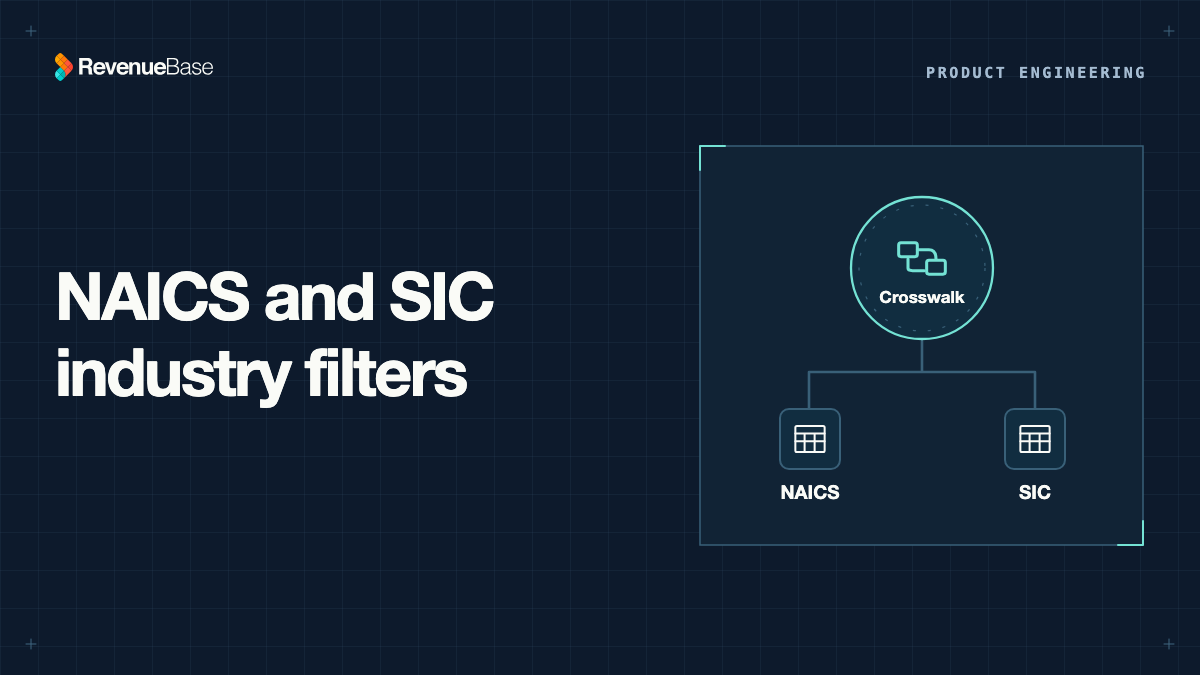
A customer asks for a list of companies in one narrowly defined industry. The supplier’s records use an older SIC code that maps to several NAICS categories. Assigning every mapped code to every company makes the list too broad. Choosing the first destination makes the result depend on the order of a spreadsheet.
The sensible object to store is a candidate mapping. Preserve the original classification, its system and vintage, the destination system and version, and the status of the evidence. The US Census Bureau’s concordance tables describe particular transitions. A table for one pair of editions cannot automatically stand in for every other pair.
Test how the two industry codes affect an actual list
RevenueBase Audience Builder
Use Exact search to select an available industry code for a buyer’s segment. Preview organizations, inspect their recorded descriptions and repeat with the alternate coding system. Record companies entering or leaving the sample. Include a diversified parent whose establishment-level activity matters to the buyer.
API
Use GET /v2/contact/company/columns?include=values to discover supported field names and available values. Ask Company Enrich for the two code fields available for known domains, such as INDUSTRY_NAICS_CODE_ORG and INDUSTRY_SIC_CODE_ORG in the data dictionary. Compare candidate sets with Company Count under each filter.
The returned company fields are observations for those records. The buyer still chooses the classification version, establishment scope and many-to-many mappings that its own product will permit.
The activity still has to belong to the business
If there is adequate evidence about the main activity of the specific establishment, use it to resolve the candidate. If only the parent’s description is available, the local unit may remain uncertain. Let the client broaden its search explicitly or leave unresolved records out. RevenueBase’s guide to NAICS gives background on how industry codes are used.
Rehearse a version change against a customer’s previous audience. Mark each record retained, added, removed or unresolved. Inspect a sample in every group. The same customer can reasonably expect an old static export to remain explainable while a current dynamic audience reflects the new definitions.
A crosswalk is useful precisely because it makes the relationship between taxonomies explicit. A bad implementation discards that relationship and returns a confident-looking industry label. If the product cannot say which source value and table produced a match, the customer has little chance of explaining a change in the next campaign.


See the data behind the argument.
Every claim we make is backed by data you can verify yourself.