How RevenueBase Company Lists Are Built and Judged
Every company list on revenuebase.ai/companies is read from the RevenueBase company graph through SmartSearch, our natural-language company search. Here is exactly how a list is built, what its numbers mean, and how a blind three-judge panel measured the matching at 86% on target.
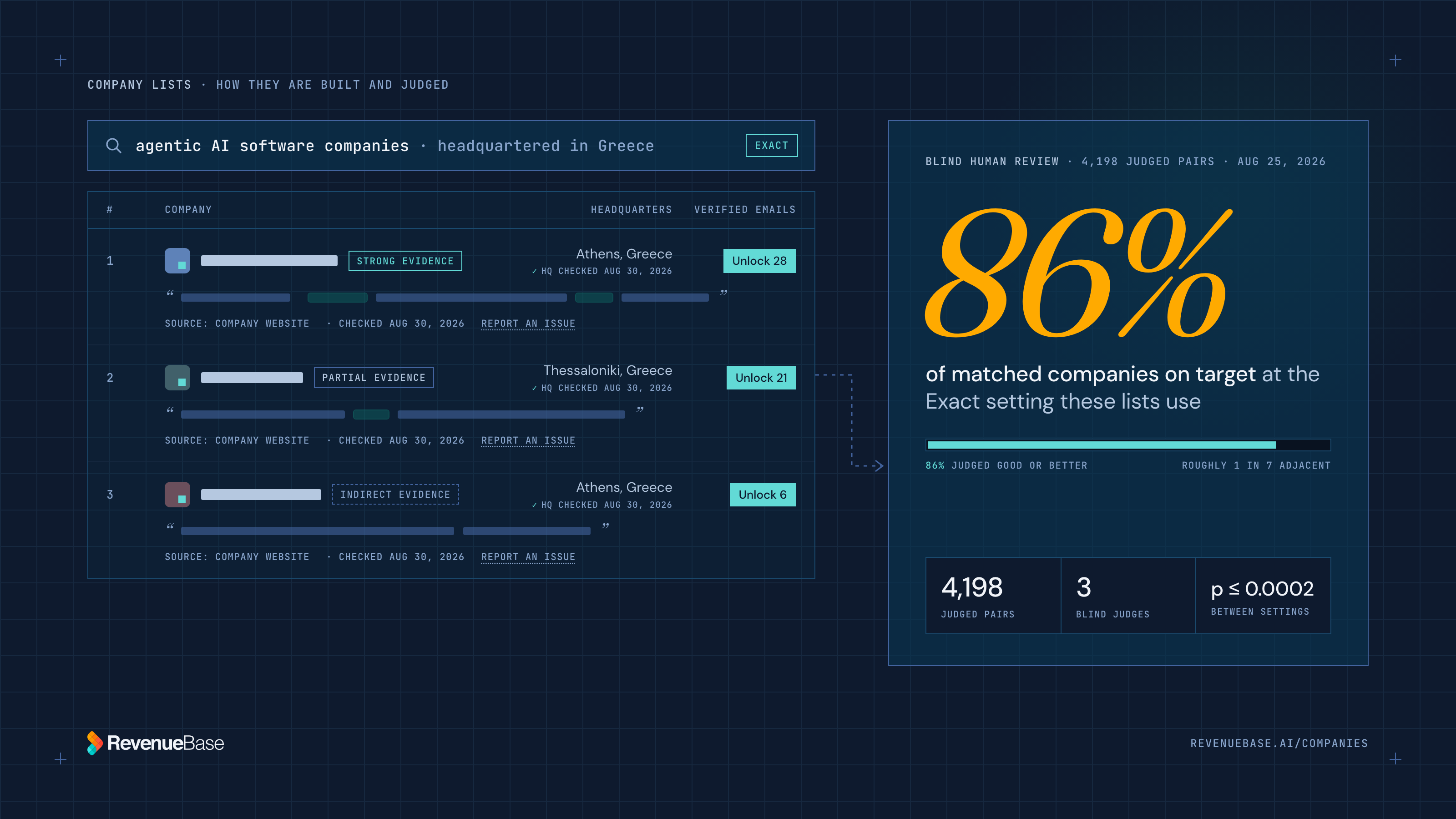
RevenueBase publishes company lists at revenuebase.ai/companies: pages such as "Agentic AI software companies based in Greece" or "Credit unions in Texas". This article explains where those lists come from, what every number on them means, and how we measured how often the matching gets it right. It is the reference every list links to.
Who publishes these lists
RevenueBase is a B2B data infrastructure company. We maintain a company graph of 60 million companies and 398.9 million professional contacts, resolved from primary sources and re-verified on a rolling cadence rather than scraped once and left to decay. Our customers use that graph through the RevenueBase platform and API to build targeted audiences, enrich their own records, and verify email addresses.
The lists are compiled by the RevenueBase Data Team, and they are built with the same product our customers use. Nothing on a list page is hand-typed research. Every count, every company, and every contact figure is read directly from the graph on a stated date.
What a list is
Every list answers one question: which companies headquartered in a place match a description of what a company does. "Agentic AI software companies headquartered in Greece" has two parts, a category and a geography, and each is checked separately.
- The category is matched with RevenueBase SmartSearch, our natural-language company search. SmartSearch reads each company's own description of its business and matches on meaning, not on industry codes or keywords. A company that calls itself a "supply chain partner" is found by a search for freight forwarders. Lists run SmartSearch at its tightest setting, Exact, which is designed to return only companies that are precisely what the description says.
- The geography is the company's registered headquarters, held in the graph as a structured field. A company with an office in Greece but headquarters elsewhere is not on the Greece list. Where a row's registered headquarters disagrees with the page's country, we flag it rather than print it as local.
A list is published only when at least 25 companies clear both checks. Below that, a page would be too thin to be useful, so we do not create one.
How a list page is built
- Count. The headline figures (companies, contacts, verified work emails, mobile numbers) come from one count over the full matched set. They are never estimated from the rows shown.
- Distributions. The employee-size and metro breakdowns are computed over the same full set.
- Rows. The table shows the largest companies in the set, ranked by team size on record: the number of professionals RevenueBase tracks at each company, then verified emails, then the company's reported employee band as a tie-break. We do not rank by the self-reported band alone, because a shell record claiming 10,001 employees on a couple of dozen tracked people would float to the top.
- Credibility floor. A row with no verified work email is dropped, and so is a row whose reported size is implausible against the people we actually track there. If too few credible rows remain, the page is not published.
- Dates. Every page states the day its figures were pulled from the graph. That date appears in the byline, on every row, and in the page's structured data, and it changes only when the page is re-pulled.
How we measured match quality: the 86%
Matching on meaning is not a database lookup, and we do not describe it as one. Every list says that in blind human judging, 86% of matched companies were on target. Here is the study behind that number.
- What was judged. On August 25, 2026 we sampled 4,198 pairs of search description and matched company from the live corpus, stratified across the full range of match strength so that every setting was tested, not only the easy end.
- Who judged. A blind three-judge panel graded each pair on how well the company fit the description. Judges saw the description and the company, never the score. The panel was calibrated against a reference set graded by RevenueBase's founder and agreed with it within one grade 92% of the time.
- The result. At the Exact setting used for lists, 86% of matched companies were graded good or better. Each of SmartSearch's four settings was statistically separated from the next (p ≤ 0.0002). The company settings were re-calibrated the same day on 1,332 fresh pairs across 12 descriptive phrases and 4 short category names, with 90.5% exact agreement between judges.
- Short searches. A one- or two-word category name such as "airlines" matches with a lower ceiling than a descriptive phrase, so Exact widens slightly for those. Measured on 240 judged pairs, 77% were good and 72% were exactly the category asked for.
- Look-alike lists. Pages that list companies similar to a named company use SmartSearch's look-alike match at Exact, measured at 85% on target in the same study and re-validated on 30 held-out seed companies.
What "on target" means: the share of companies on a list that a careful human, reading the company's own description, agrees belongs there. The remaining companies are mostly adjacent to the category rather than wrong: a machine-learning consultancy on an agentic AI software list, a general marketing agency on a demand-generation list. Expect roughly one row in seven to be adjacent, and read each row's own description to decide for yourself.
What every row shows you
- The company's own words. The first sentence of its description, with the words it shares with the list's category marked.
- An evidence rating. Strong, partial, or indirect, based on whether that sentence names the category, part of it, or neither. It is a reading aid so you can check the match yourself, not a confidence score. The matching itself reads the company's full profile, not only the sentence shown.
- Source and date. A link to the company's website and the day the row was checked.
- Headquarters. City and country from the registered headquarters field, with its own check date where the graph carries one.
- Report an issue. Wrong category, wrong headquarters, or a closed company can be reported in one click. Reports go to the RevenueBase Data Team and feed back into the graph.
What the lists do not claim
- A list is what RevenueBase identified, not a census. "RevenueBase identified 66 agentic AI software companies headquartered in Greece" means 66 companies in our graph cleared both checks on the stated date. Companies with no verified work email, or none we track, are not counted.
- Descriptions are the companies' own. A company that describes itself vaguely can match a category weakly or miss it.
- Counts are exact for the stated date and change as the graph is re-checked. Lists refresh periodically.
- On lists in markets RevenueBase itself competes in, RevenueBase appears once as a labelled, unranked row. It is never assigned a rank or a score.
- Category definitions and introductory sentences are written from templates. For many categories the definition text is drafted with AI assistance and machine-checked so that every figure binds to the right count. No figure on any page comes from a text generator. All of them come from the graph.
Build your own list
Everything above is available to any RevenueBase user. SmartSearch is the same search in the RevenueBase platform and the API: describe the companies you want in plain language, add a geography, a size band, or a job title, and get the companies plus verified emails and direct dials for the people at them. A free account includes 500 credits for audience building, contact downloads, or email verification. Developers can read the SmartSearch reference in our documentation.
How to cite a list
RevenueBase Data Team. "Top 16 agentic AI software companies based in Greece." RevenueBase, data refreshed August 30, 2026. https://revenuebase.ai/companies/agentic-ai-software-companies/greece
Each page carries its own refresh date and a machine-readable Dataset description with the same figures, so a citation can name the exact day the numbers were read.

Take it further
See the data behind the argument.
Every claim we make is backed by data you can verify yourself.