Best Email Verification Tools in 2026 (and How to Choose One)
A fair rundown of the leading email verification tools — ZeroBounce, NeverBounce, Bouncer, Kickbox, Hunter, and built-in verifiers — plus the criteria that actually separate them: catch-all resolution, real-time and bulk, privacy, pricing model, and whether a tool can fix the data, not just label it.

TL;DR: The best email verification tool comes down to one question: do you just need a label on each address, or do you need the underlying data fixed too? For pure verification, ZeroBounce, NeverBounce, Bouncer, Kickbox, and Hunter are all credible, and Apollo-style built-in verifiers are fine as a first pass. We built RevenueBase for teams who want 97%+ accuracy that resolves catch-alls and can repair or supply the missing data — without per-credit metering. Test any of them on a matched sample before you commit.
What email verification does, and why it matters
Email verification checks whether an address is real and deliverable before you send to it. That sounds small. It isn't. Every hard bounce tells mailbox providers like Google and Microsoft that you don't maintain your list, and that signal compounds: bounce too often and your sender reputation drops, your inbox placement with it, and even your clean contacts stop landing in the inbox. For B2B teams the stakes are higher, because business email churns constantly as people change jobs and companies rename domains. So this is ongoing hygiene, and your tool should fit both bulk cleaning of imported lists and real-time checks before a send.
How to choose an email verification service
Most vendors look similar on a feature grid. Here is what actually separates them:
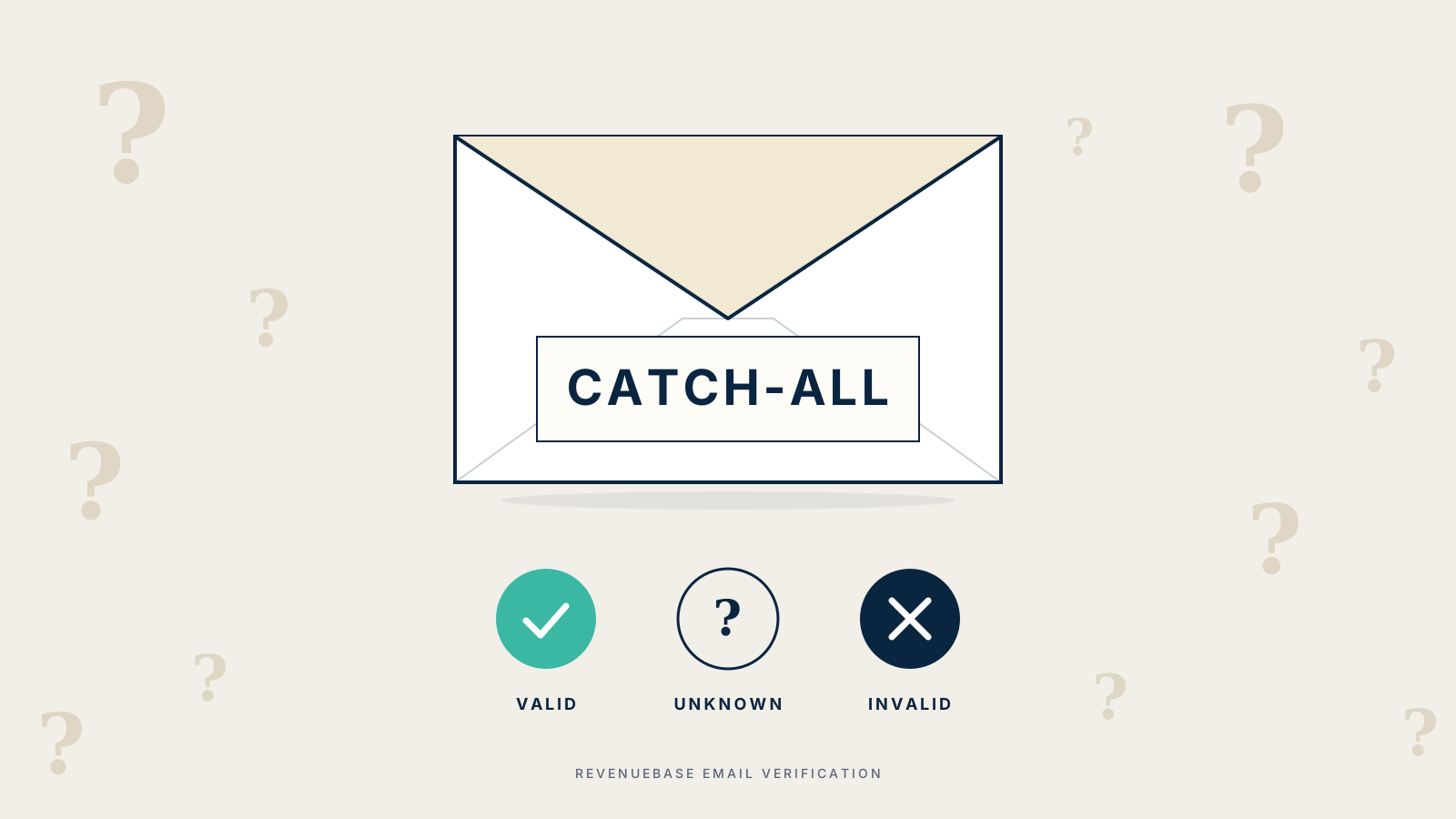
- Accuracy, especially on catch-all domains. Anyone can confirm an obviously valid or dead address. The hard cases are catch-all domains, where the server accepts everything and most tools throw up their hands with an “unknown” or “risky” label. A catch-all is not a mailbox status — it's a verifier admitting it doesn't know (more on that in why catch-all isn't a mailbox status). The fewer addresses dumped into the unknown bucket, the more usable your list.
- Real-time API and bulk both. You need an API for forms and pre-send checks and a bulk path for cleaning lists you import. Make sure it's fast, well-documented, and plugs into your ESP, CRM, and sequencer rather than forcing CSV exports.
- Data privacy and method. Some verifiers send test or “probe” emails, which can annoy recipients and trip spam traps. Existence-based verification confirms an address without ever sending to it. Ask which method a vendor uses and where your data goes.
- Pricing model. Per-credit pricing punishes hygiene — every recheck costs money, so teams verify less than they should. Flat-rate or per-outcome removes that friction. Check whether you pay for “unknown” results, since on a catch-all-heavy list that's a big share of the bill.
- Labels only, or labels plus repair? Most tools stop at valid/invalid/unknown, which doesn't help if the right answer is a different, correct address for the same person. When a tool flags an address bad, can it also give you the good one?
The main tools, fairly
Each is a legitimate choice. Here is what each is genuinely good at:
ZeroBounce
One of the most established names, with a broad feature set beyond verification — activity data, scoring, and spam-trap detection. Best for teams who want a full-featured hygiene suite and don't mind credit pricing.
NeverBounce
A reliable, no-frills bulk and real-time verifier with a long track record and solid ESP integrations, priced per credit. Best for teams that want a trusted verifier bolted onto an existing stack.
Bouncer
A clean, modern verifier popular in Europe that leans hard on data privacy and GDPR posture, with a good API and transparent pricing. Best for privacy-conscious, especially EU-based teams who want a focused tool, not a marketing suite.
Kickbox
Well-regarded for deliverability expertise and a developer-friendly API, with a Sendex quality score and a focus on sender reputation. Best for engineering teams embedding real-time verification into a product or signup.
Hunter (Email Verifier)
Hunter is primarily a prospecting and email-finding tool, and its verifier is a natural companion. Best for small teams and founders already using Hunter who want a quick verification pass in the same place; as a standalone bulk verifier, it's less of a fit than the tools above.
Apollo and other built-in verifiers
Many sales platforms — Apollo among them — include a built-in verification step on the contacts they surface. Convenient and fine as a first filter, but they tend to be conservative on the hard cases, often hand back the same “unknown” on catch-all domains, and ask you to trust the vendor that supplied the data to grade its own work. Worth a second opinion before a big send.
RevenueBase
We'll be direct about where we fit. RevenueBase is built for teams whose real problem isn't labeling emails — it's having correct, deliverable contact data. Our verification is existence-based, never sends test emails, and runs against more than a billion verification signals a month, which is how we hit 97%+ accuracy and resolve catch-alls that other tools mark unknown. We return a clean valid/invalid/unknown — no “catch-all” or “risky” hedge buckets. The difference that matters most: when an address is wrong, we don't just flag it, we can supply or repair the right one from our base of 390M+ contacts and 60M+ companies. And pricing is per-outcome or flat-rate, not per-credit, so re-verifying doesn't feel like spending money. If you only need a yes/no label, a point verifier is fine; if you need the data to be right, that's us.
FAQ
What is the most accurate email verifier?
Accuracy varies by list, so the honest answer is “test on your own data.” On catch-all-heavy B2B lists, the gap shows up in how many addresses end up “unknown.” RevenueBase resolves 97%+ rather than hedging — the number to compare on a matched sample.
What's the difference between SMTP probing and existence-based verification?
SMTP probing pings the mail server, sometimes sending test messages, to infer whether an address exists — noisy, often blocked, and liable to trip spam traps. Existence-based verification confirms an address without sending to it.
Do I need real-time verification, bulk, or both?
Most teams need both: real-time at the point of capture (forms, signups, pre-send) and bulk for cleaning imported lists. Pick a tool that does well at your primary use; check the API if you embed it.
Why do so many tools return “catch-all” or “risky”?
A catch-all domain accepts every address, so a naive check can't tell a real mailbox from a fake one. “Catch-all” and “risky” are really a verifier saying “we don't know.” Better tools resolve more of those instead of passing the uncertainty to you.
Can a verifier fix a bad address instead of just flagging it?
Most can't — they only label. RevenueBase can both verify and supply or repair the correct address from its data, the main reason teams pick it over a pure point verifier.
How often should I re-verify my list?
B2B data decays fast as people change jobs. Re-verify before any major send and on a rolling schedule for active lists — exactly why per-credit pricing gets in the way, making the right cadence costly.
The bottom line
There's no single “best” email verifier — there's the best one for your job. If you need a clean yes/no label, ZeroBounce, NeverBounce, Bouncer, Kickbox, and Hunter all serve well. If your real problem is that the data itself is wrong, you want a tool that resolves catch-alls and can repair the record, priced so good hygiene doesn't cost you every time.
Don't take anyone's accuracy claim on faith, including ours. Run a head-to-head test: take one matched sample, run it through two or three tools at once, and compare the percentage marked valid, the percentage dumped into “unknown,” and how many “valid” results actually land. The tool with the smallest unknown bucket and highest real inbox rate wins. Verify a sample list free at app.revenuebase.ai and see how it compares to whatever you're using now.
Take it further
See the data behind the argument.
Every claim we make is backed by data you can verify yourself.