First-Party vs. Third-Party Intent Data: When Do They Change the Sales Queue?
A buyer’s direct question and a third-party topic alert both deserve attention. They support different kinds of sales action.
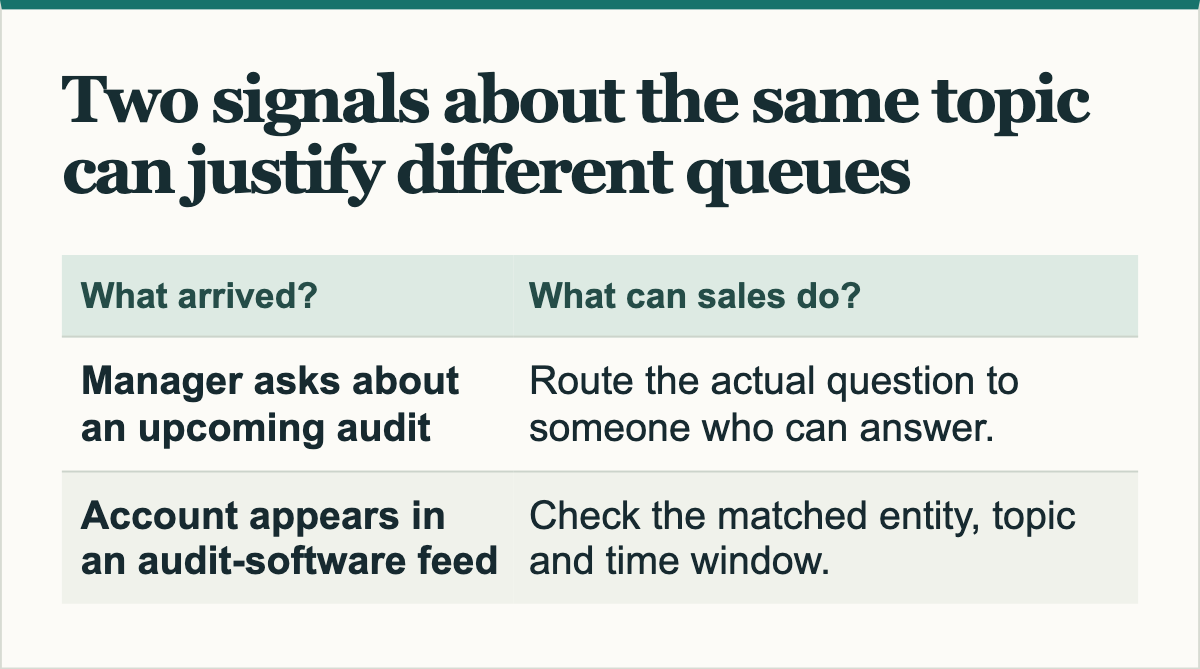
A procurement manager asks whether a supplier can help with an upcoming audit. Elsewhere, a third-party feed says a target company has been reading about audit software. Both records may land in a queue labeled “intent.” Only one contains a question an identifiable person actually asked.
For the procurement manager, preserve the question and assign someone able to answer it. For the topic alert, establish the matched entity, period, subject and provider’s method. A company researching a subject may be preparing a purchase, investigating a client’s problem or simply doing its ordinary work. A seller can research the account without suggesting that a particular executive has been observed reading something.
Bombora distinguishes activity visible within a company’s own experiences from information obtained from other sources. Vendors’ definitions and units matter. HubSpot’s buyer intent workflow, for example, includes company-level signals. Preserve the underlying observation rather than letting a single score erase the difference.
Hold fit constant while comparing the two intent signals
Start with a consistent target universe in RevenueBase Audience Builder. Under Exact search, set company country, employee band and relevant industry. Inspect Companies and retain a dated list of approved company IDs and domains. Join each source’s observed company to that common list before comparing how many new accounts it adds to the sales queue.
When intent records arrive with domains, the API can resolve candidates through POST /v2/contact/company/enrich. Keep the provider, signal timestamp and scope in separate fields. Two signals that point to one organization can be compared as account observations. Neither that match nor a title at the company identifies the individual who researched a topic.
Ask whether the paid signal added an account
Begin with a consistent set of companies that fit the market. Compare those with first-party activity, third-party activity, both or neither. Separate opportunities already far along in the sales process; research may follow a seller’s work as easily as precede it. Examine accepted research tasks, independently confirmed needs and eventual opportunities over a meaningful period.
Count the additional qualified accounts a paid source introduces beyond those already on the team’s list. A stream of alerts about familiar customers may produce a busy dashboard and very little incremental coverage. The buyer of intent data needs to know what decision changed: which previously overlooked account deserved research, which rep had a specific question to answer, and which alert required no new action.


See the data behind the argument.
Every claim we make is backed by data you can verify yourself.